
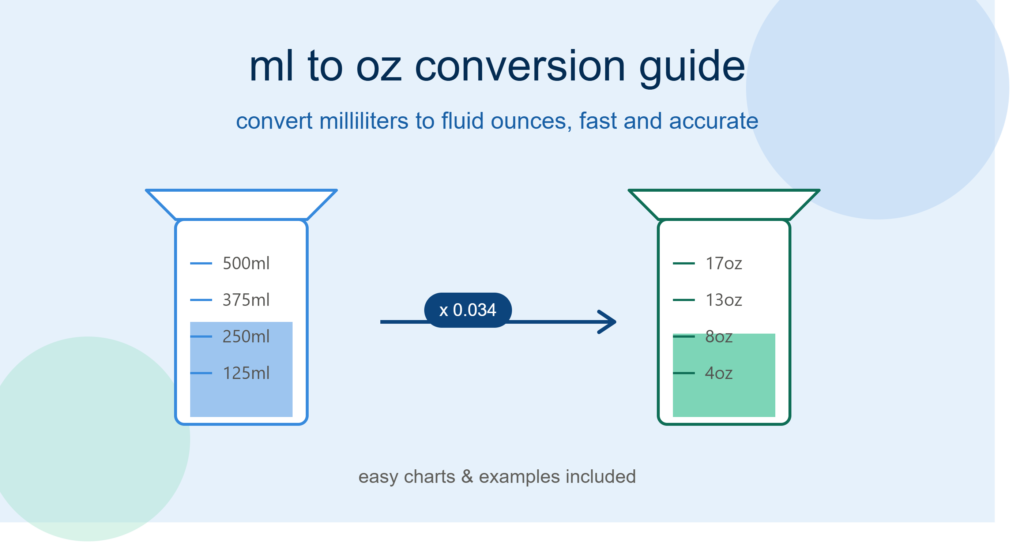
Have you ever looked at a recipe and wondered, “How many ounces are in a milliliter?” Maybe you picked up a cosmetic bottle or measured out medicine and felt confused by the numbers. You’re not alone. At ProPackInsights, we know that accurate measurements matter — not just in the kitchen, but in packaging, manufacturing, shipping, and product labeling too.
Whether you’re measuring liquids for personal use or business needs, knowing how to convert mL to oz saves you from costly mistakes and keeps your measurements spot on.
This guide covers everything you need to know about milliliters to ounces — conversion formulas, quick-reference tables, real-world examples, and common measurement mistakes people make every day.
Quick Answer: mL to Oz Conversion
The simplest way to convert milliliters (mL) to US fluid ounces (fl oz) is by using this formula:
Fluid Ounces = Milliliters ÷ 29.5735
Example
- 100 mL = 3.38 oz
- 200 mL = 6.76 oz
- 300 mL = 10.14 oz
- 500 mL = 16.91 oz
- 1000 mL = 33.81 oz
This formula is the standard conversion used in the United States for liquid measurements.
What Is a Milliliter (mL)?
A milliliter (mL) is a unit of volume in the metric system.
It is commonly used for measuring:
- Water
- Milk
- Juice
- Cooking oils
- Medicines
- Cosmetics
- Perfumes
- Cleaning liquids
- Laboratory chemicals
One milliliter equals one-thousandth of a liter (0.001 L).
Because most countries use the metric system, milliliters are found on food packaging, cosmetic labels, and pharmaceutical products worldwide.
What Is a Fluid Ounce (oz)?
A fluid ounce (fl oz) measures liquid volume in the US customary and Imperial systems.
Unlike ounces used to measure weight, fluid ounces measure volume.
You’ll commonly see fluid ounces on:
- Beverage bottles
- Shampoo containers
- Lotion packaging
- Protein drinks
- Cleaning products
- Essential oils
Knowing the difference between weight ounces and fluid ounces is essential because they are not interchangeable.
mL to Oz Conversion Formula
To convert milliliters into US fluid ounces:
Fluid Ounces = mL ÷ 29.5735
Reverse Formula
If you want to convert ounces back into milliliters:
Milliliters = Fluid Ounces × 29.5735
These formulas work for nearly every liquid product you’ll encounter.
mL to Oz Conversion Chart
The following table answers many of the most searched questions online.
| Milliliters (mL) | US Fluid Ounces (oz) |
| 5 mL | 0.17 oz |
| 7 mL | 0.24 oz |
| 9 mL | 0.30 oz |
| 30 mL | 1.01 oz |
| 40 mL | 1.35 oz |
| 50 mL | 1.69 oz |
| 60 mL | 2.03 oz |
| 80 mL | 2.71 oz |
| 100 mL | 3.38 oz |
| 110 mL | 3.72 oz |
| 130 mL | 4.40 oz |
| 150 mL | 5.07 oz |
| 180 mL | 6.09 oz |
| 200 mL | 6.76 oz |
| 300 mL | 10.14 oz |
| 500 mL | 16.91 oz |
| 530 mL | 17.92 oz |
| 551 mL | 18.63 oz |
| 560 mL | 18.93 oz |
| 580 mL | 19.61 oz |
| 1000 mL | 33.81 oz |
| 1600 mL | 54.10 oz |
This chart covers many of the conversion values users search for, making it a handy reference for everyday use.
Common mL to Oz Conversions
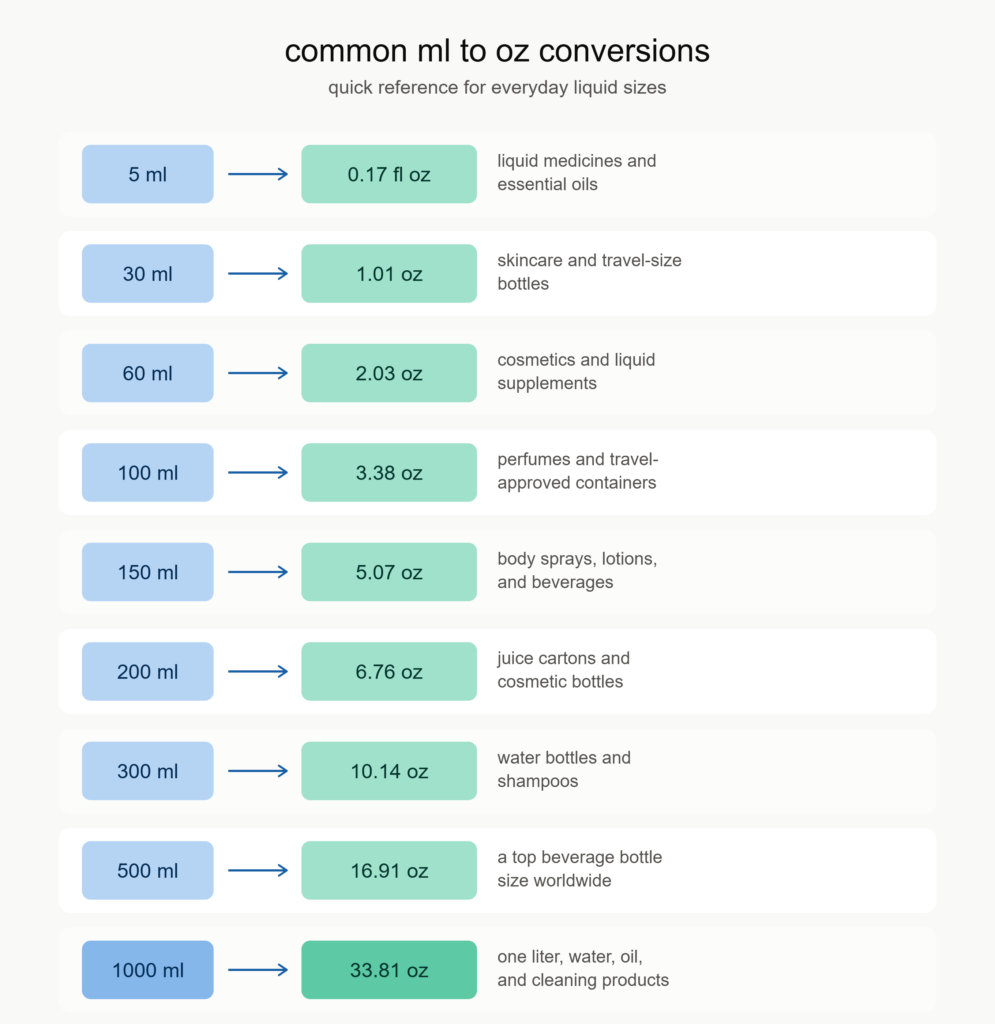
How many ounces is 5 mL?
5 mL = 0.17 US fluid ounces
This amount is commonly used for liquid medicines and essential oils.
How many ounces is 30 mL?
30 mL = 1.01 oz
Many skincare products and travel-size bottles use this capacity.
How many ounces is 60 mL?
60 mL = 2.03 oz
A popular size for cosmetic products, liquid supplements, and sample containers.
How many ounces is 100 mL?
100 mL = 3.38 oz
You’ll often find this size on perfumes, facial cleansers, and airline-approved travel containers.
How many ounces is 150 mL?
150 mL = 5.07 oz
Frequently used for body sprays, lotions, and beverage packaging.
How many ounces is 200 mL?
200 mL = 6.76 oz
A common size for juice cartons, cosmetic bottles, and liquid detergents.
How many ounces is 300 mL?
300 mL = 10.14 oz
Often used for reusable water bottles, shampoos, and food containers.
How many ounces is 500 mL?
500 mL = 16.91 oz
One of the most popular beverage bottle sizes worldwide.
How many ounces is 1000 mL?
1000 mL = 33.81 oz
Equivalent to one liter and commonly found in water, cooking oil, and household cleaning products.
US Fluid Ounces vs UK (Imperial) Fluid Ounces
One of the most common conversion mistakes is assuming all fluid ounces are the same.
They are not.
| Measurement | Equivalent |
| 1 US Fluid Ounce | 29.5735 mL |
| 1 Imperial Fluid Ounce | 28.4131 mL |
Although the difference seems small, it becomes significant when measuring large quantities.
For packaging, exporting, or international product labeling, always verify whether you’re using US fluid ounces or Imperial fluid ounces.
Why Accurate Conversions Matter
Converting milliliters to ounces isn’t just helpful for recipes. Accurate conversions are essential across many industries.
Examples include:
- Food packaging
- Beverage manufacturing
- Cosmetics
- Pharmaceuticals
- Laboratory testing
- Chemical production
- E-commerce product listings
- Shipping and labeling
Incorrect measurements can result in inaccurate labels, customer confusion, or packaging that doesn’t comply with regional standards.
Real-World Example: Packaging a Cosmetic Product
A skincare brand once ran into a simple but costly problem. Their bottle held 100 mL, but the marketing material listed it as 4 oz. That’s wrong — 100 mL equals 3.38 oz, not 4 oz.
Catching the error before production saved them from printing misleading labels. It also kept them in line with international packaging standards.
It’s a small mistake, but it shows why getting unit conversions right matters — especially when your product is sold in different countries.
Everyday Examples of mL to Oz Conversions
Understanding liquid conversions becomes much easier when you see how they apply in daily life. Here are a few common examples where converting milliliters to ounces is useful.
In the Kitchen
Recipes from different countries often use different measurement systems. A European recipe may list ingredients in milliliters, while an American recipe uses fluid ounces.
For example:
- 250 mL of milk ≈ 8.45 oz
- 500 mL of broth ≈ 16.91 oz
- 1000 mL of water ≈ 33.81 oz
Using the correct conversion helps maintain the intended taste and texture of your recipe.
Cosmetic Products
Most skincare and beauty products display both milliliters and ounces.
Common examples include:
| Product | Typical Size |
| Travel perfume | 30 mL (1.01 oz) |
| Facial serum | 50 mL (1.69 oz) |
| Body lotion | 200 mL (6.76 oz) |
| Shampoo | 300 mL (10.14 oz) |
| Conditioner | 500 mL (16.91 oz) |
For cosmetic manufacturers, displaying both units improves customer understanding in international markets.
Beverage Packaging
Drink manufacturers commonly produce bottles in metric sizes while marketing them using fluid ounces in countries like the United States.
Examples include:
| Bottle Size | Equivalent |
| 250 mL | 8.45 oz |
| 330 mL | 11.16 oz |
| 500 mL | 16.91 oz |
| 750 mL | 25.36 oz |
| 1000 mL | 33.81 oz |
These conversions are especially useful when comparing beverage packaging across regions.
Medicine and Healthcare
Liquid medicines are usually measured in milliliters because metric measurements provide greater precision.
For example:
- 5 mL = 1 teaspoon (approximately)
- 10 mL = 2 teaspoons
- 15 mL = 1 tablespoon
Always use the measuring device supplied with the medication and follow healthcare instructions. Household spoons should not be used as measuring tools.
Common mL to Oz Conversion Mistakes
Even though the formula is straightforward, mistakes still happen. Here are the most common ones to avoid.
Confusing Fluid Ounces with Weight Ounces
A fluid ounce measures volume, while a regular ounce measures weight. They are not the same unit.
Mixing US and Imperial Ounces
One US fluid ounce is different from one Imperial (UK) fluid ounce. Always verify which system applies to your product or recipe.
Rounding Too Early
For accurate product labeling, pharmaceutical applications, or manufacturing, avoid rounding numbers too soon. Keep additional decimal places until the final calculation.
Ignoring Packaging Requirements
Many countries require products to display metric and customary units. Incorrect conversions can lead to labeling issues and customer confusion.
Why Packaging Professionals Use Both mL and Oz
Packaging engineers, manufacturers, and product designers deal with customers from all over the world. That means one label doesn’t always work everywhere.
A bottle made for European markets might only show milliliters. That same product sold in North America often needs both milliliters and fluid ounces on the label.
Showing both measurements makes a real difference. It helps customers understand what they’re buying, keeps you in line with labeling regulations, cuts down on purchasing mistakes, and makes international distribution much smoother.
At ProPackInsights, we’ve seen small labeling inconsistencies cause big production delays. A quick check on your unit conversions before packaging goes to print can save you from expensive fixes down the road — and makes sure your product meets expectations in every market.
Real-World Example: Beverage Label Review
A beverage company was getting their packaging ready for international markets. The European label only needed to show 500 mL — straightforward enough. But the North American version required both 500 mL and 16.91 fl oz on the label.
Spotting this early — before anything went to print — saved the team from reprinting thousands of labels. That’s a costly mistake nobody wants.
The conversion itself wasn’t complicated. But applying it correctly made all the difference. The final packaging was compliant, clear, and easy for customers in every market to understand.
Quick Reference Conversion Table
Here are additional values frequently searched online.
| Milliliters | US Fluid Ounces |
| 4 mL | 0.14 oz |
| 20 mL | 0.68 oz |
| 70 mL | 2.37 oz |
| 90 mL | 3.04 oz |
| 120 mL | 4.06 oz |
| 160 mL | 5.41 oz |
| 220 mL | 7.44 oz |
| 350 mL | 11.83 oz |
| 400 mL | 13.53 oz |
| 600 mL | 20.29 oz |
| 750 mL | 25.36 oz |
| 1500 mL | 50.72 oz |
Related Guides
If you’re interested in measurements, dimensions, and packaging standards, you may also find these ProPackInsights guides useful:
- How Many Grams in an Ounce? — Learn how to convert weight measurements accurately.
- What Is Width and Length? — Understand dimension order for packaging and product specifications.
- Playing Card Size Guide — Standard card dimensions and packaging considerations.
- Bankers Box Dimensions — Compare standard storage box sizes for documents and archives.
These resources can help you better understand how measurements influence packaging, storage, shipping, and product design.
Final Thoughts
Converting milliliters to ounces is a simple calculation, but it’s an essential skill in everyday life and across industries such as food production, cosmetics, healthcare, manufacturing, and packaging. Whether you’re foConverting milliliters to ounces isn’t complicated — but it’s a skill that comes up more than you’d think. Recipes, medicine labels, beverage bottles, product packaging — accurate conversions matter in all of them. Get it wrong, and it can cost you time, money, and credibility. The number to remember is simple: one US fluid ounce equals 29.5735 milliliters. Keep the conversion formula or tables in this guide handy whenever you need a quick answer. Once you get comfortable with both metric and customary units, working with products from different parts of the world becomes a lot easier.
FAQs
How many mL are in one ounce?
One US fluid ounce equals 29.5735 milliliters.
How many ounces are in 100 mL?
100 mL equals 3.38 US fluid ounces.
How many ounces are in 200 mL?
200 mL equals 6.76 US fluid ounces.
How many ounces are in 300 mL?
300 mL equals 10.14 US fluid ounces.
How many ounces are in 500 mL?
500 mL equals 16.91 US fluid ounces.
How many ounces are in 1000 mL?
1000 mL equals 33.81 US fluid ounces.
Is 30 mL equal to 1 ounce?
Almost. Thirty milliliters equals 1.01 US fluid ounces.
Is 5 mL equal to one ounce?
No. Five milliliters equals 0.17 US fluid ounces.
What is the easiest way to convert mL to oz?
Divide the number of milliliters by 29.5735 to get US fluid ounces.
Why do product labels show both mL and oz?
Displaying both units helps consumers understand product volume and meets labeling expectations in different markets.

Pingback: Cereal Box Dimensions: Standard Sizes & Measurements Guide