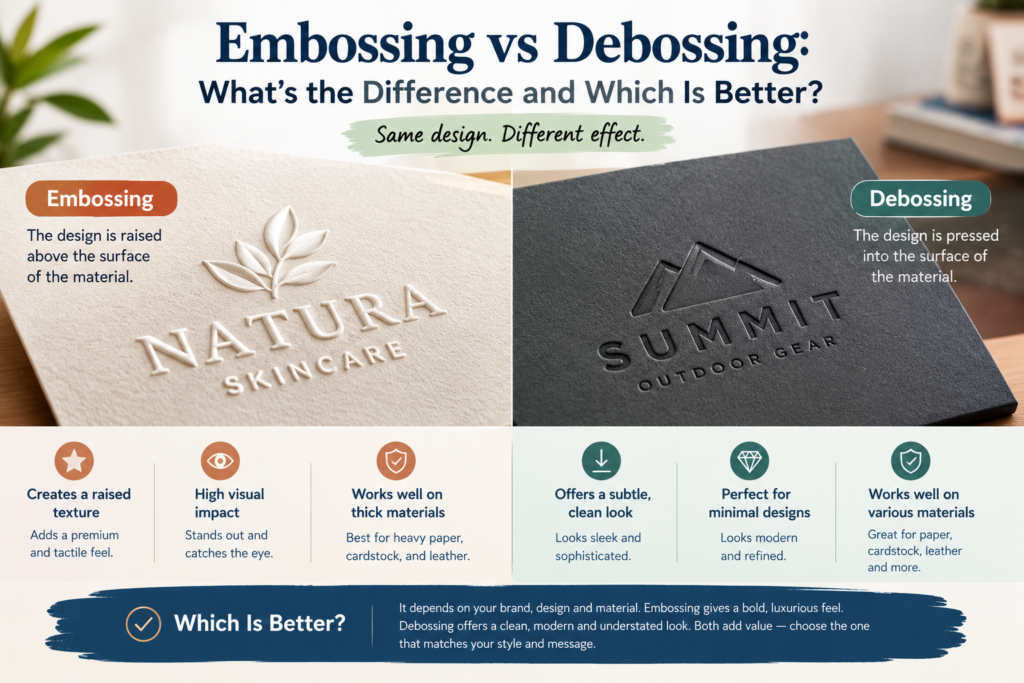
Run your thumb across a premium box lid and you’ll often feel the logo before you read it. That’s embossing or debossing doing its quiet work. At ProPackInsights, we get asked about the two all the time, mostly because they’re easy to mix up and surprisingly easy to specify wrong when you’re briefing a printer. The short version: embossed means raised, debossed means pressed in. The longer version, including which one actually suits your packaging, is below.
Embossing vs Debossing at a Glance
| Embossed | Debossed | |
| Effect | Design rises above the surface | Design sinks below the surface |
| Feel | Raised, you can trace it with a fingertip | Recessed, a smooth dip |
| Look | Bold, catches light along its edges | Subtle, shadow gathers inside |
| Best for | Logos you want noticed and touched | Understated marks, leather, covers |
| Back of the sheet | Shows a matching dent | Shows a matching bump |
What Does Debossed Mean?
Debossed means formed into the material in such a way that the design is below the level of the surrounding surface. This is achieved through pressure from a die, usually with some heat applied. It is important to note that material is displaced, rather than removed. A person can tell if a logo is debossed on a surface if they run their fingertip over it and feel an indentation.
The technique can be used on paper, board, leather, plastic and certain metals, making it common across notebooks, handbags and hard gift boxes.
What Is a Debossed Logo?
A debossed logo is formed into the surface of a material, rather than printed on top of it. It can be “blind”, with no ink used apart from the natural or foil finish of the material, or have foil or ink used to fill the recessed area for more contrast. You may find debossed logos on leather goods, hardcover books, product packaging and the premium-feel lids of luxury packaging, particularly where a presence is preferred to a prominent graphic.
What Is Embossing?
Embossing is creating a raised image on a substrate by impressing it from the other side using a die. The raised effect can be seen and felt in three dimensions, and holds shadows that give it more dramatic visual impact than a debossed mark.
Common uses include book covers, certificates and seals, business cards, invitations and rigid or folding cartons, where a tactile highlight is wanted.
What Is the Opposite of Embossed?
The opposite of embossed is debossed – in common language you might describe this as indented or recessed – but debossed is the technical antonym, and the word printers will be looking for. Similarly with the opposite of embossing, which is debossing.
Difference Between Emboss and Deboss: Debossed vs Embossed Compared
The fundamental difference between emboss and deboss is direction. One raises the impression, one indents it, and this feeds into everything else. The impact in terms of light and shadow, wear and handling, materials suitability and general impression are all dictated by this.
Light and shadow: raised elements will cast shadows on their edges, giving embossing a more dramatic effect. Indented areas will hold in shadows too, giving a more subtle appearance.
Wear and handling: raised elements can be prone to coming off under rubbing or heavy stacking, while indented areas are slightly protected by the surrounding material. This is a generalisation, as the thickness of the stock will also contribute to the likelihood of wear.
Materials: both require a relatively heavy stock to hold an impression, though uncoated or lightly coated board is thick enough. Thin paper is likely to tear or lose definition.
How Embossing and Debossing Are Made
Both embossing and debossing use a pair of metal dies (one with the image and one as a counter), with the sheet being pressed between them to achieve the impression. Which side of the sheet the impression is on dictates whether it will appear as embossed or debossed. Turning the sheet over will mean the same impression is now on the other side, with whatever was a raised area now becoming indented.
Embossed Side Meaning
You may come across the phrase “embossed side”. This is in reference to the side that has the raised image impressed onto it. Turning the sheet over, this would appear as a faint indentation, which is an easy way to identify an embossed card. Embossed cards will often have a slight indentation on the reverse, and this is a handy tip to bear in mind.
Embossed or Debossed: Which Is Better?
It’s hard to name one winner, as they both have their own uses, and the better choice will depend on what you’re trying to achieve.
For embossing, opt for this if you want the mark to stand out and be noticed, the artwork is clean and simple and the stock is thick enough to achieve the depth you’re after. Combine it with foil for a premium look.
For debossing, this is ideal for marks that are more discreet, across a large area such as a lid or cover, or on a surface that will be handled frequently. Leather also lends itself to this technique.
Both techniques can be combined if you’re looking for a design with raised and indented elements (such as a debossed field with an embossed mark or sculpted multi-level marks) to add more dimension to the impression, without extra ink.
Cost is harder to judge than most articles will suggest, as both techniques will require custom dies, and the determining factor for price is the size and complexity of the die. Ask your printer to quote for both before assuming that one will be significantly cheaper than the other.
Context also plays a part, as quiet luxury packaging relies heavily on blind deboss and soft-touch surfaces. That is why you’ll find it mentioned often in our breakdown of minimalist packaging design styles, and where to use tactile finishes in your packaging design is further explored in our guide to packaging design trends for 2026.
Engrave vs Deboss: Not the Same Thing
These two terms are often used interchangeably, but there is a fundamental difference, and the difference is that engraving always involves removing material. This can be achieved with a laser, a cutting tool or an etched plate, and the resulting effect will be a groove with sharp edges, with the removal of material from the surface. Debossing, however, displaces material into a recess, without removing it.
This has an impact on what each technique can be applied to; engraving is suitable for wood, metal, glass and acrylic while debossing is suitable for paper, board and leather.
What about engraved vs embossed? In stationery, engraved often refers to intaglio printing, where ink is pushed into the paper and can come out on the other side slightly raised, or with a dent on the back of the paper. Embossing does not require any ink at all, and is purely about the impression.
Embossed vs Debossed Leather
Leather is an incredibly good material to work with for both embossing and debossing, as it takes the impression cleanly with heat and pressure. Vegetable-tanned leather in particular holds crisp impressions. Debossed logos are the preferred choice for many leather goods, including wallets, belts and notebooks, as a press mark on the surface holds up well and ages beautifully. Embossed leather more frequently refers to a pattern impressed across the whole surface, such as a grain or reptile texture.
Coated, thin or synthetic leather can behave differently, and can be scalded by excessive heat, so a sample is always a good idea.
Digital vs Traditional Embossing
Traditional embossing uses metal dies tailored to your artwork, giving the crispest edges and deepest impression. The cost of the die is usually spread out across your print run. Digital techniques bypass the need for metal dies; some systems build up a raised clear coating, and some work with short-run tooling. This means that the set-up is faster, and cheaper, for smaller print runs or bespoke work, but you sacrifice the depth and precision of a traditional impression.
A rough rule of thumb is to go with traditional embossing for larger print runs, and digital embossing for smaller ones.
Tips Before You Order Embossing or Debossing
There are a few practical pointers to reduce costs and avoid rework.
- Choose the right stock: thick, uncoated or lightly coated board will hold an impression better than heavily coated or laminated sheet. Our packaging materials guide has more information on substrates for premium finishes.
- Keep artwork bold: very fine lines and small text risk filling in or disappearing. It’s better to keep things simple and use confident strokes that hold up.
- Avoid folds and edges: impressions near a fold or at the very edge of a sheet risk splitting.
- Think twice about corrugated: corrugated board is engineered to maintain its structure, and deep impressions risk damaging the flutes. Finer E and F flutes can work well with printed, premium finishes, as our guide to corrugated flute types explains.
- Request a sample: a die proof or a physical sample will give more information about the impression in terms of depth and edges, rather than a mockup.
FAQs
What is the difference between embossing and debossing?
Embossing raises a design above the surface, and debossing presses it below. The same technique and dies are used, but the direction is opposite.
What does debossed mean?
It means a design has been pressed into a material so it sits lower than the surrounding surface, creating a recessed impression.
What is the opposite of embossed?
Debossed. Indented or recessed are plain-English equivalents, but debossed is the correct technical term.
Is embossing or debossing better?
Neither is better in every case. Embossing is bolder and more tactile, while debossing is subtler and suits handled surfaces like leather and covers.
What is a debossed logo?
A logo pressed into a surface instead of printed on top. It can be blind (no ink) or filled with foil or color.