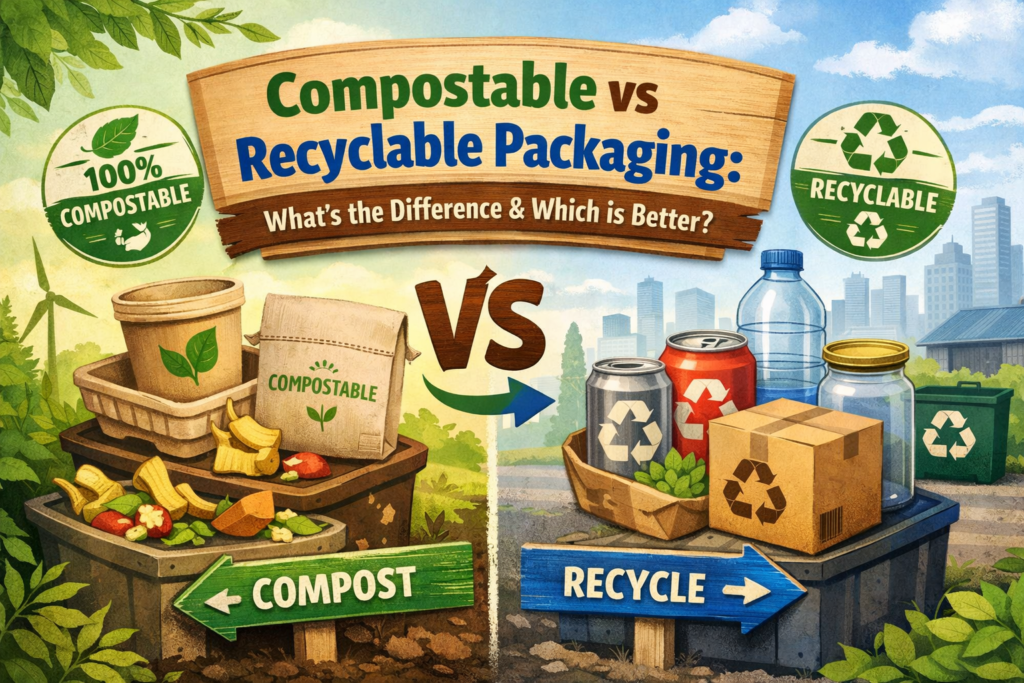
Compostable vs Recyclable Packaging, which is better? Sustainable packaging is no longer optional—it’s a necessity. Businesses worldwide are shifting toward eco-friendly solutions, but confusion still exists between compostable and recyclable materials. At Propackinsights, we help simplify these decisions so brands can choose packaging that aligns with sustainability goals and global regulations.
In this guide, we’ll break down compostable vs recyclable packaging, helping you understand which option is best for your product and business model.
Compostable vs Recyclable: Key Differences
Understanding compostable vs recyclable packaging starts with how each material is processed after use.
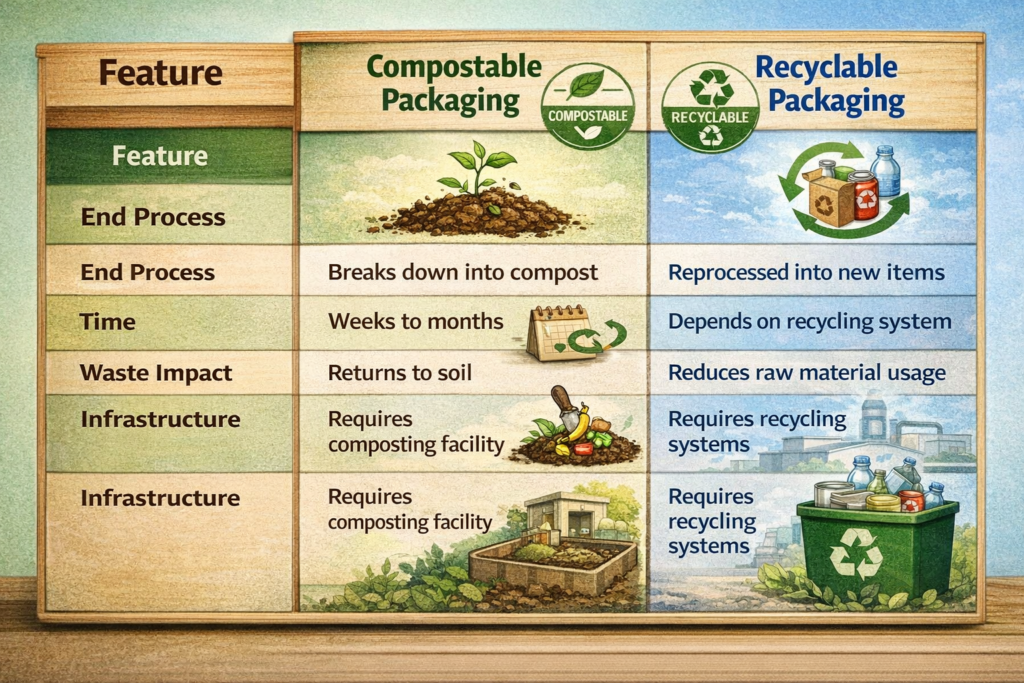
👉 Compostable = returns to nature
👉 Recyclable = reused into new products
What is Compostable Packaging?
Compostable packaging is made from natural materials that decompose into nutrient-rich soil under the right conditions.
Compost vs Recycle: Basic Understanding
When comparing compost vs recycle, composting turns waste into organic matter, while recycling transforms materials into new products.
Benefits of Compostable Packaging
- Reduces landfill waste
- Supports soil health
- Made from renewable resources
- Breaks down naturally
Limitations
- Requires industrial composting facilities
- Not always suitable for long shelf-life products
- Limited availability in some regions
What is Recyclable Packaging?
Recyclable packaging includes materials like paper, plastics, aluminum, and glass that can be reprocessed and reused.
Recyclable vs Compostable Packaging Explained
In the debate of recyclable vs compostable, recyclable materials focus on reuse, while compostable materials focus on decomposition.
Benefits of Recyclable Packaging
- Widely accepted in global systems
- Reduces need for virgin materials
- Cost-effective for large-scale production
Limitations
- Requires proper sorting and infrastructure
- Can degrade in quality after multiple cycles
- Not all materials actually get recycled
Recycling vs Composting: Which is More Sustainable?
The debate of recycling vs composting depends on environmental impact and local infrastructure.
Recycling vs Composting Comparison
- Recycling:
- Saves raw materials
- Works well for metals and glass
- Requires energy for processing
- Composting:
- Produces natural fertilizer
- Ideal for organic waste
- Limited by facility access
👉 In regions with strong recycling systems, recycling is often more practical.
👉 In eco-focused markets, composting is gaining popularity.
Composting vs Recycling: When to Choose What?
Choose Compostable Packaging If:
- Your product is organic or food-based
- You target eco-conscious consumers
- Composting facilities are accessible
Choose Recyclable Packaging If:
- You operate globally
- You need durability and longer shelf life
- Recycling systems are well established
For a broader view of material choices, you can explore our guide on packaging materials types and global trends, which compares multiple packaging solutions.
Compostable vs Recyclable Packaging in Global Markets
- Europe & UK: Strong push toward compostable materials
- USA: Advanced recycling infrastructure
- Asia: Growing adoption of both systems
This GEO-based variation plays a major role in deciding the right packaging strategy.
Environmental Impact: Compostable vs Recyclable
Which is Better for the Environment?
- Compostable packaging reduces organic waste and supports soil regeneration
- Recyclable packaging reduces resource extraction and energy consumption
👉 There is no one-size-fits-all answer—the best choice depends on your supply chain and region.
Future Trends in Sustainable Packaging
- Rise of hybrid packaging (compostable + recyclable elements)
- Improved composting infrastructure globally
- Increased regulations on plastic use
- Consumer demand for transparency
Sustainability is becoming a competitive advantage in packaging decisions.
Final Thoughts
The debate between compostable vs recyclable packaging is not about which is better universally, but which is better for your specific use case. Compostable packaging supports natural decomposition, while recyclable packaging enables material reuse at scale.At Propackinsights, we aim to guide businesses toward smarter, sustainable packaging choices. To deepen your understanding, you can also explore our article on biodegradable packaging materials uses and benefits, which connects closely with compostable solutions.
FAQs
What is the difference between recyclable and compostable packaging?
Recyclable packaging is processed and reused to create new products, while compostable packaging breaks down into natural elements like water, CO₂, and organic matter. In simple terms, recyclable materials are reused, whereas compostable materials return to the earth.
What are the 7 main types of plastic?
The 7 main types of plastic are classified by resin codes:
PET (Polyethylene Terephthalate) – used in water bottles
HDPE (High-Density Polyethylene) – used in milk containers
PVC (Polyvinyl Chloride) – used in pipes and packaging films
LDPE (Low-Density Polyethylene) – used in plastic bags
PP (Polypropylene) – used in food containers
PS (Polystyrene) – used in foam packaging
Other (Mixed plastics) – includes polycarbonate and bioplastics
Is glass or aluminum more eco-friendly?
Both are eco-friendly, but aluminum is often considered more efficient due to its lightweight nature and lower transportation emissions. Glass, however, is non-toxic, reusable, and fully recyclable, making it ideal for purity-focused products.
Can compostable packaging be put in any compost bin?
No, not all compostable packaging can go into any compost bin. Many compostable materials require industrial composting facilities with controlled heat and conditions. Some items labeled “home compostable” can be safely composted at home, but it’s important to check the certification.
What is the difference between compostable and recyclable packaging?
Compostable packaging breaks down into natural elements, while recyclable packaging is processed and reused to create new products.
Which is better: compostable or recyclable packaging?
It depends on your region and product. Compostable is better for organic waste, while recyclable is more practical for global systems.
What is compost vs recycle?
Compost turns waste into nutrient-rich soil, while recycling converts materials into new products for reuse.
Is compostable packaging environmentally friendly?
Yes, it reduces landfill waste and supports soil health, but it requires proper composting conditions.
Why is recyclable packaging important?
Recyclable packaging helps reduce resource consumption and supports a circular economy.