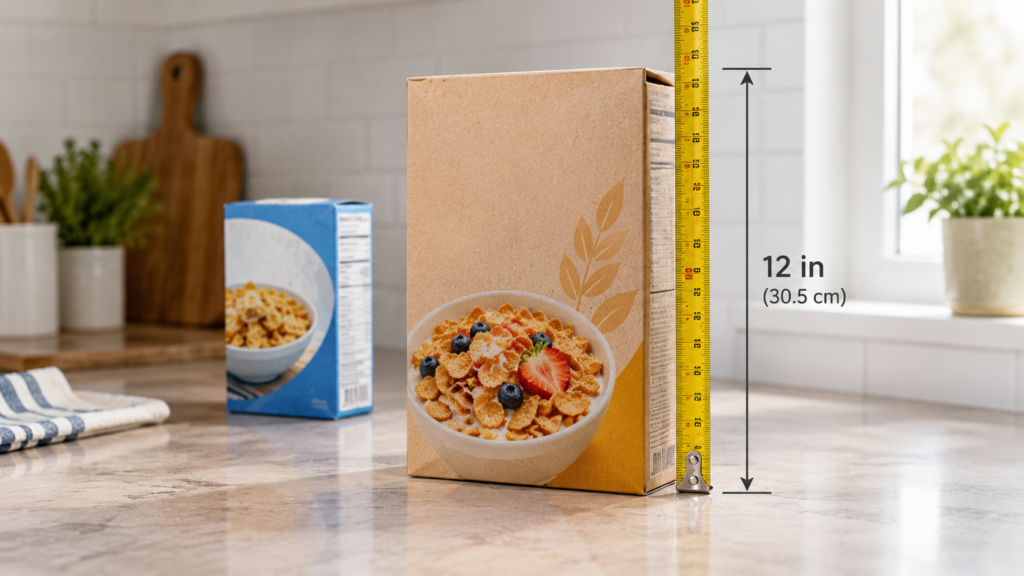
At Propackinsights, we put the standard cereal box at about 12 inches tall, 7.5 to 8 inches wide, and 2 to 2.5 inches deep (30.5 x 19.1 to 20.3 x 5.1 to 6.4 cm). Family-size boxes run a little taller and noticeably deeper. Most boxes hold 12 to 18 ounces of cereal.
If you’re lining up a dieline, checking shelf fit, or just settling an argument about how big a cereal box really is, the numbers below will get you there. We pulled the ranges from brand listings and packaging references, checked the math ourselves, and flagged the spots where sources disagree.
Standard Cereal Box Size Is About 12 x 8 x 2.5 Inches
The standard cereal box size is roughly 12 inches tall by 8 inches wide by 2.5 inches deep, which converts to 30.5 x 20.3 x 6.4 cm. Real boxes shift a quarter inch here and there from brand to brand, so treat these as working numbers rather than a spec sheet.
Cereal Box Dimensions in Inches and cm
| Box type | Height | Width | Depth | Typical net weight |
| Mini or single serve | 6 to 8 in (15.2 to 20.3 cm) | 4 to 5 in (10.2 to 12.7 cm) | 1.5 in (3.8 cm) | About 1 oz (28 g) |
| Standard | 12 in (30.5 cm) | 7.5 to 8 in (19.1 to 20.3 cm) | 2 to 2.5 in (5.1 to 6.4 cm) | About 12 oz (340 g) |
| Family size | 12.5 to 13 in (31.8 to 33 cm) | 7.5 to 8 in (19.1 to 20.3 cm) | 2.75 to 3.9 in (7 to 9.9 cm) | 18 to 22 oz (510 to 620 g) |
| Giant or mega | 13.5 to 15 in (34.3 to 38.1 cm) | 9.5 to 11 in (24.1 to 27.9 cm) | 3 to 4 in (7.6 to 10.2 cm) | 24 to 27 oz (680 to 770 g) |
Sources disagree by an inch or so, especially on family and giant boxes. These are ranges, not promises, so measure the exact box you plan to match.
Regular and Average Cereal Box Size
Shoppers say regular, normal, or average. Manufacturers say standard or 12 oz. They all point to the same thing: the roughly 12 inch tall box that sits on most grocery shelves and holds somewhere between 12 and 18 ounces.
A Box of Cereal Stands About 12 Inches Tall
A standard box of cereal is about 12 inches (30.5 cm) tall, and most mainstream brands land within an inch of that. Mini boxes drop to 6 to 8 inches, while family and giant boxes climb to roughly 12.5 to 15 inches.
Why Cereal Box Height Stays Consistent
Shelf spacing is the most likely reason. A grocery shelf only gives so much vertical room, so brands tend to grow a box’s depth or width before they grow its height. Look at the Cheerios numbers below: going from the regular box to the family box adds under an inch of height but over an inch of depth.
Family Size Cereal Box Dimensions Add Depth More Than Height
A family size cereal box is usually 12.5 to 13 inches tall, about 7.7 inches wide, and 2.75 to 3.9 inches deep. The extra cereal goes into thickness, which keeps the box fitting the same shelf.
Cheerios Box Dimensions by Size
Brands rarely publish official carton dimensions, so these figures come from packaging references and retail listings. A retail listing for an 18 oz family Cheerios box shows estimated shipping dimensions of about 12.8 x 7.77 x 3.9 inches, which lines up with the table.
| Brand and size | Approx. height x width x depth (in) |
| Cheerios regular (about 12 oz) | 12 x 7.5 x 2.5 |
| Cheerios family (about 18 oz) | 12.8 x 7.7 x 3.7 |
| Cheerios mega (24 to 27 oz) | 13.5 x 9.5 x 3.1 |
| Frosted Flakes regular (about 12 oz) | 12 x 7.75 x 2.5 |
| Frosted Flakes family (about 21.7 oz) | 12.5 x 7.75 x 3 |
| Lucky Charms family (about 18.6 oz) | 13 x 7.7 x 2.75 |
A few other guides list the family Cheerios box at 14 x 8 x 3 inches. That gap is a good reminder that one source is never enough when a print file depends on the number.
Volume and Surface Area of a Cereal Box Come From Three Measurements
You only need height, width, and depth to work out both volume and surface area. Volume is height x width x depth. Surface area is 2 x (height x width + height x depth + width x depth).
Cereal Box Volume
For a 12 x 8 x 2.5 inch box, the volume is 240 cubic inches (about 3,933 cm³). Drop the depth to 1.75 inches and it falls to 168 cubic inches (about 2,753 cm³). Always rerun the multiplication yourself, because a few published guides quote a volume that doesn’t match their own dimensions.
Surface Area of a Cereal Box
Using the same 12 x 8 x 2.5 inch box, the surface area is 2 x (96 + 30 + 20), which gives 292 square inches (about 1,884 cm²). That figure helps you estimate board and print coverage. A real dieline needs more material than the number alone, since it adds glue flaps and tuck flaps.
Cereal Box Weight and Net Weight Are Two Different Numbers
The 12 oz or 18 oz printed on the front is net weight, which means the cereal alone. The full box weighs more because the carton and liner add their own weight. Under FDA food labeling rules (21 CFR Part 101), net quantity excludes the container and any packing, solid foods are declared by weight, and the statement appears in both US and metric units in the lower 30 percent of the front panel.
How Many Ounces Are in a Box of Cereal
Standard boxes hold 12 to 18 ounces (340 to 510 g). Cheerios alone ships everywhere from 8.9 oz to 27.2 oz (252 to 771 g), according to one packaging reference. If you’re switching between units, one ounce is about 28.35 grams, and our guide to converting grams to ounces walks through the math.
How Much Does a Box of Cereal Weigh
Expect the gross weight to run a few ounces over the label. One retail listing for an 18 oz family Cheerios box shows an estimated shipping weight of 1.38 pounds, or about 22 ounces. That’s roughly 4 ounces above the net weight, and it includes packaging.
Cups of Cereal in a Box Depend on the Cereal, Not Just the Box
A box holds anywhere from a few cups to about 20 cups, depending on box size and how dense the cereal is. Many size guides quote 8 to 12 cups for a standard box, and that range works for denser cereals. Light, puffy cereal fits far more.
How to Calculate Cups From the Label
Multiply servings per container by the serving size in cups. A retail listing shows an 18 oz family Cheerios box with 13 servings, and Cheerios lists a serving as 1 1/2 cups. That works out to roughly 19 to 20 cups. Treat it as an estimate, since labeled serving sizes are approximations and cereal settles during shipping.
Cereal Box Materials and Liners Shape the Final Dimensions
Most cereal boxes are paperboard cartons with an inner liner bag, and both affect how much product actually fits. The walls are only a few hundredths of an inch thick, but that’s enough to make inside dimensions slightly smaller than outside ones. The liner, not the carton, does most of the work keeping cereal crisp.
For a quick tour of paperboard, plastic, and the other options, see our overview of common packaging materials. Once the boxes leave the factory, they usually travel in larger shipping cases, and our breakdown of types of corrugated packaging explains how those cases are built.
How to Measure a Cereal Box Correctly
Measure the outside of the box standing upright, and always record height, width, and depth in that order. A tape measure or ruler is enough.
- Stand the box on its base, front facing you.
- Measure height from the bottom edge to the top edge.
- Measure width across the front panel, side to side.
- Measure depth along the narrow side panel, front to back.
- Multiply all three to get volume.
Suppliers don’t all agree on which side counts as the width, so confirm the convention before you order. Our explainer on what width and length mean in packaging covers the common definitions.
Cereal Box Dimensions for Custom Packaging Need Fill and Fit Checks
If you’re designing a custom cereal box, size the carton to the real fill volume, not just the look you want. Cereal settles during shipping, so some empty space at the top is normal. FDA does treat unnecessary empty space as potentially misleading, though, so an oversized box can cause trouble.
A few habits save money:
- Confirm net weight and fill volume before you set the box depth.
- Ask for a white sample and test it on a real shelf.
- Leave tolerance for paperboard thickness and fold lines.
- Check how many boxes fit in the shipping case you plan to use.
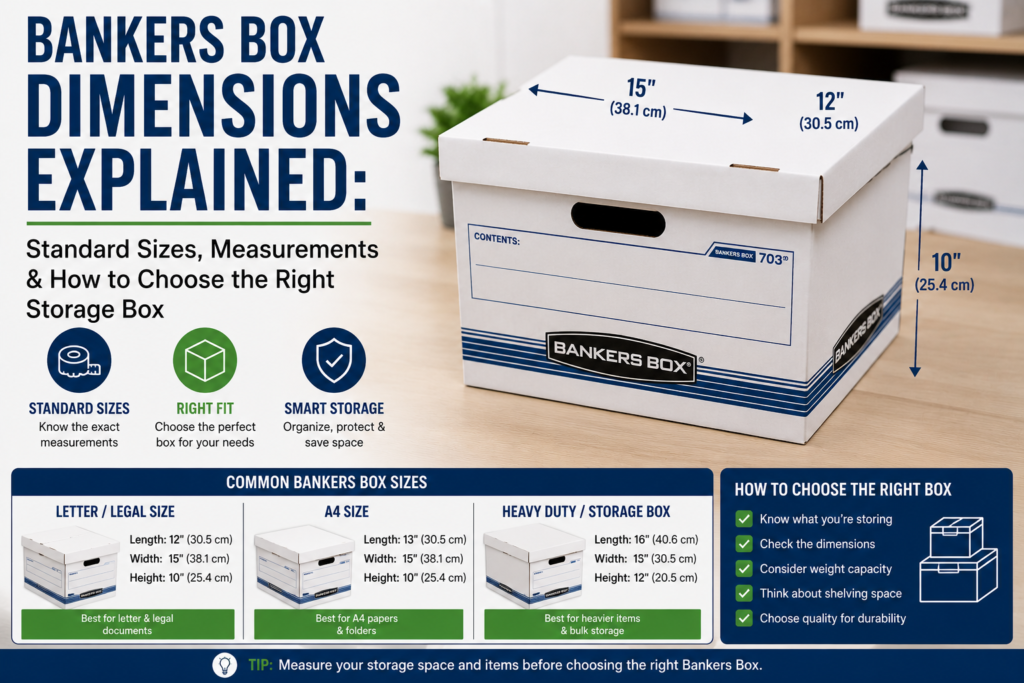
On that last point, comparing carton formats helps. Our guide to bankers box dimensions shows how a storage box is sized very differently from a retail carton.
FAQs
How tall is a box of cereal?
A standard box of cereal is about 12 inches (30.5 cm) tall. Family boxes run 12.5 to 13 inches, and mini boxes run 6 to 8 inches.
What are the dimensions of a standard cereal box?
A standard cereal box is about 12 inches tall, 7.5 to 8 inches wide, and 2 to 2.5 inches deep. In centimeters, that’s 30.5 x 19.1 to 20.3 x 5.1 to 6.4.
What are the dimensions of a family size cereal box?
A family size box is typically 12.5 to 13 inches tall, 7.5 to 8 inches wide, and 2.75 to 3.9 inches deep. Depth varies the most between brands.
How many cups of cereal are in a box?
It depends on the cereal. Divide servings per container by the label’s serving size in cups. An 18 oz family Cheerios box works out to roughly 19 to 20 cups.
How many ounces are in a box of cereal?
Standard boxes hold 12 to 18 ounces (340 to 510 g). Mini boxes hold about 1 ounce, and giant boxes can reach 27 ounces.