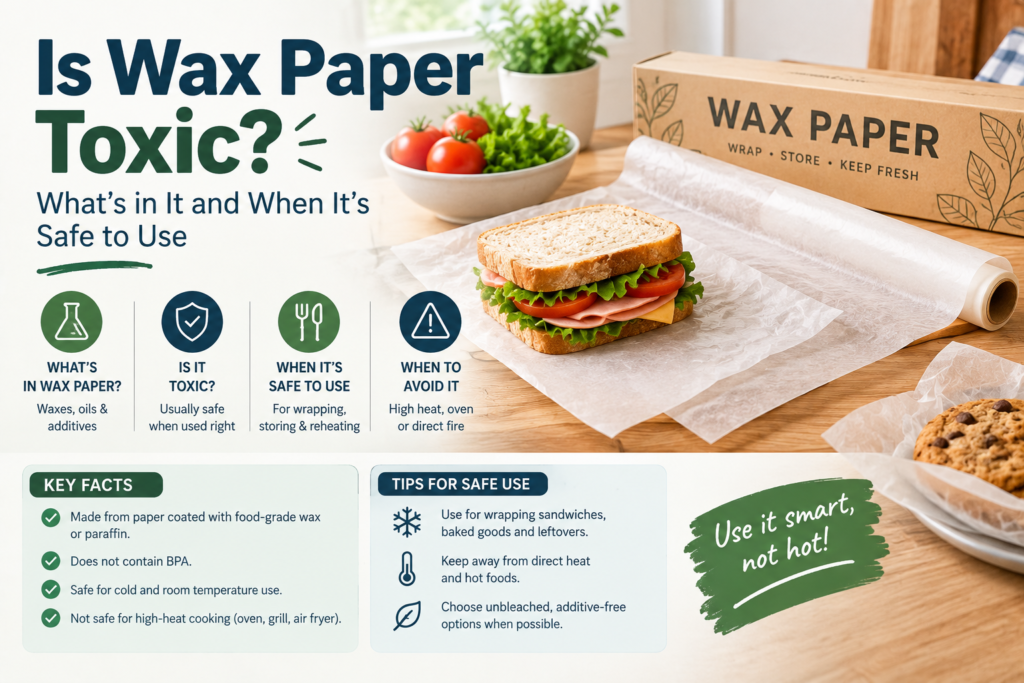
Most of us grab wax paper without a second thought, then freeze when a recipe says “bake” and the roll in our hand definitely isn’t parchment. At ProPackInsights we spend a lot of time on food-contact papers and coatings, and wax paper is the one that triggers the most nervous questions. Is it poisonous? Will it catch fire? What if a toddler chewed a corner? The reassuring part comes first: wax paper isn’t toxic when you use it the way it was designed to be used. The real risk is heat, and that’s where most mistakes happen.
Quick Answers
| Question | Short answer |
| Is wax paper toxic? | No, not for cold or room-temperature food |
| Can wax paper go in the oven? | Not directly. It melts, smokes and can ignite |
| Is wax paper edible? | No. It isn’t poisonous, but it can’t be digested |
| Can you microwave it? | Short, loosely covered reheats are generally fine |
| Is it recyclable? | Usually not in curbside paper recycling |
Is Wax Paper Toxic?
Short answer: No. Wax paper is simply paper with a thin coating of food-grade wax, and this type of wax is approved for food contact by the United States. Consider the uses to which wax paper is typically put: wrapping around a sandwich, laying between layers of a baked good, or underneath a ball of rolled-out dough. These are all fairly low-temperature and short-duration applications, and exactly the use to which the wax coating is suited.
The word that makes people nervous is “paraffin.” Paraffin wax is a petroleum byproduct and sounds rather industrial, but the food-grade variety has been thoroughly refined to a point of chemical stability. The same type of paraffin wax is used to coat cheese rinds and produce — and no one is under any illusion that a waxed cheese wheel is dangerous.
What Chemicals Are in Wax Paper?
Fewer than you might expect. There are two components to wax paper: paper fibers made of plant material, and a wax coating. On a typical store-bought roll the wax coating is food-grade paraffin. “Natural” variations of wax paper use soybean wax or beeswax in place of paraffin (and some brands use a mix of the various waxes or add other ingredients to alter the feel and flexibility of the coating). There isn’t a long list of additives, but if you’re the type to care, the outside of the box will tell you which wax a particular brand uses.
Does Wax Paper Have Plastic in It?
The traditional kind does not. Paraffin wax is a type of hydrocarbon wax, not a plastic polymer. The reason that people confuse wax paper with plastic is because of variations made for different purposes: freezer paper has a plastic film adhered to one side, and some commercially printed takeout wrappers use a thin layer of polyethylene in place of a wax coating. If a surface feels more like a plastic bag than a waxed paper, assume that it probably is.
If you need a more in-depth look at differences between plastic- and paper-based packaging, our guide to plastic vs paper packaging goes into more detail about the strengths and weaknesses of each material.
Can You Put Wax Paper in the Oven?
Not directly. The melting point of food-grade paraffin is around 120 to 150 degrees Fahrenheit — and a standard oven is set to 350 degrees. The wax paper begins to melt, smoke, and can drip down onto whatever is beneath it, and at higher temperatures the paper itself can ignite. It should also be noted that several competing articles give 200 degrees as the failure point of wax paper, and this should not be considered a safe working temperature.
Will Wax Paper Melt or Burn?
Both, actually. Wax and paper are both fuel, and wax paper is therefore flammable when temperatures rise or when it comes in contact with an open flame. Air fryers and convection ovens have an additional danger in that a light sheet of paper can be caught up in the air currents and land on the heating element. Broilers and stovetops are off-limits as well.
Can You Bake on Wax Paper?
This is one of the few places where other articles fail to give an accurate nuance to the rule. Reynolds, the manufacturer of Cut-Rite wax paper, advises that wax paper should not be subject to direct oven heat, but may be used to line a baking pan for cakes, quick breads, and muffins if the batter fully covers the wax paper. The contents of the baking pan provide a barrier to the heat, and the wax paper is therefore protected. That does not mean that a cake, placed directly on top of a sheet of wax paper, is safe — it means that a fully covered pan of batter is safe.
If you need help discerning the differences between wax paper, butter paper, and parchment paper, our comparison of wax paper, butter paper, and parchment paper goes over the exact differences and temperatures each is rated for.
What to Do If You Accidentally Used Wax Paper in the Oven
If you’ve accidentally used wax paper in the oven, chances are there were no visible flames or smoke. Regardless, follow these instructions in order:
1. Turn the oven off.
2. If there is only smoke, open a window and turn on the vent fan while waiting for the oven to cool. Remove the tray/pans with oven mitts once the smoke has stopped.
3. If there are visible flames, do not open the oven. Once the fire has gone out (there will be no visible flame), turn the oven off and remove the tray/pans with oven mitts. Do not throw water on the fire, and call emergency services if the flames do not immediately go out.
4. Check the contents of the pan. If wax has dripped or melted onto any of the food, throw it away. Melted wax will produce an unpleasant flavor, and is not meant to be ingested. If the wax paper peeled off cleanly from a pan of fully-covered batter, it is safe to continue baking.
5. Clean the tray/pans while the wax is still warm and pliable. Wash with hot, soapy water to remove the wax.
Is Wax Paper Safe for Baking and Food Contact?
It is safe for cold food, room-temperature food, and paper items. Wax paper is ideal for wrapping sandwiches, creating a barrier on countertop surfaces while making cookies, separating layers of candy or patties in the freezer, rolling out dough, and letting baked goods cool on a rack when they come out of the oven. Where it fails is anything very hot or very greasy, which could strip wax off the paper and deposit it onto the food.
In the microwave, Reynolds states that their wax paper is suitable for use as a spatter cover while reheating or defrosting, with the caveat that short bursts of microwave time should be used with loose coverings. Avoid using wax paper over hot, greasy foods. If you want a detailed overview on the use of their silicone-coated parchment paper in the microwave, here is our guide to microwaving parchment paper.
Can You Eat Wax Paper? Is It Edible?
No. Paper is cellulose, which is indigestible, and paraffin wax, which simply passes through your system unhindered. There is no nutritional value in eating wax paper, but it is generally harmless in small quantities — with the caveat that wax paper is manufactured to be food-safe, not edible.
What Happens If You Eat Wax Paper?
A small quantity, such as a corner torn out and accidentally eaten while removing a sandwich from wax paper, will pass through unhindered with no ill effects. At larger quantities or if you were to eat the entire contents of a wax paper bag, discomfort and cramps may occur (especially in young children), but it is unlikely that any real harm would come from eating wax paper.
If a child swallows a large quantity of wax paper, or if you or anyone else experiences vomiting, continuous stomach cramps, or difficulty swallowing, contact a doctor or Poison Control (in the U.S. you can contact 1-800-222-1222). This is general information, not medical advice. If a dog eats a large quantity of wax paper, contact your vet.
Is Parchment Paper Toxic When Heated?
Parchment paper is the other safer option for the oven, but it has its limits as well — most brands use a silicone coating and a safe temperature range is somewhere around 420 to 450 degrees, with some room for error. Read your box, since it may say something different. Going over those temperatures will begin to char the parchment paper, making it brittle and setting it on fire at higher temperatures. Burnt parchment paper is not toxic (as a rule), but it does not belong in your food, so remove any charred bits.
It is worth noting that “baking paper” is another name for parchment paper.
Is Wax Paper Recyclable, Biodegradable or Compostable?
It is the coating that determines whether wax paper can be recycled, composted, or tossed in the trash — most curbside paper recycling programs will not take wax paper for the same reason that it cannot be composted: the wax does not separate from the paper fibers during the pulping process, and most of it will end up in the trash. Some brands are now certifying their plant-based wax papers for commercial composting, and several companies print this information on the package. Composting at home takes more time and is less reliable, but it will still break down in the right environment. If you want a more detailed overview on the breakdown process for various materials, here’s our overview of biodegradable packaging materials.
Safer Alternatives to Wax Paper for Baking
Wax paper makes a good substitute for parchment paper in many situations, but when the oven is involved it is always best to use either parchment paper or a silicone baking mat. Greased pans work for many baking tasks as well, and aluminum foil is suitable for roasting or baking tasks where the food isn’t likely to stick to the metal. Use wax paper for all of your other paper needs.
FAQs
Is wax paper toxic?
No. Used on cold or room-temperature food, wax paper is considered safe. The risk comes from heat, which can melt the coating and cause smoke or fire.
Can you put wax paper in the oven?
Not directly. The wax melts and smokes at typical baking temperatures. The only common exception is a pan liner fully covered by batter, as some manufacturers allow.
Is wax paper safe for baking?
Only as a pan liner under fully covered batter. For cookies, roasting or anything exposed to the oven, use parchment paper.
Can you eat wax paper?
It isn’t poisonous, but it isn’t edible. Your body can’t digest it, so a small accidental bite normally passes without trouble.
What happens if I accidentally cooked with wax paper?
Turn the oven off, ventilate if it’s smoking, and discard any food the wax melted into.
Does wax paper burn?
Yes. Both the wax and paper are flammable, especially near a heating element or in an air fryer.
Is wax paper non-stick?
Yes, for cold and room-temperature use. The wax coating releases food easily until heat gets involved.